Action to address climate change can drive strong, sustainable growth. The state is central in setting the direction of change and mobilising investment and innovation to achieve it. But time is not on our side. Research to guide policy has never been more urgent; it must proceed alongside action.
This article is part of an upcoming collection on state capacity and industrial strategy by the Policy Hub for the Huth Initiative for a New Political Economy.
The new growth story of the 21st century must be about sustainability and resilience, and with artificial intelligence (AI) at centre stage. It will be very different to the polluting and unsustainable models that so many countries have followed. Private investment will be at the core. But the role of the state will be critical in making it happen. The task of governments and public institutions is to devise comprehensive strategies, policies and institutions that can foster transformation across all economic sectors.
The role of the state must include setting incentives, aligning expectations and spurring innovation and entrepreneurship. It will be in the vanguard of system change, including in our cities, energy, transport, land and water.
This requires a clear strategic vision, tackling market failures and encouraging private investment in new areas. At the same time, it must manage the socio-economic and political challenges arising from dislocation and vested interests. And it must be aware of and avoid the dangers of government failure. In so doing, it must beware both market and institutional fundamentalisms.
These are ambitious tasks that require a renewed and effective state. This article outlines key dimensions of the state action that are needed to enable this growth story. Together, they form both a sense of direction and a research agenda. Because of the urgency, action and learning must go together. There will be mistakes along the way, but this should not be an argument for inaction. Delay is dangerous.
This is a time of crisis – and a new growth story is needed
Much of the global political landscape is currently divided. Across the world, there has been erosion of constitutional democracy. Some of this is related to the sluggish economic growth that the world has been experiencing, eroding living standards for many, undermining communities and leading to anger and discontent.
In this context, climate action has been characterised by many as an issue for elites. Yet it is not sustainability-aligned policy that has led the world to its current state. On the contrary, the lack of it has contributed to the difficulties. Climate inaction creates instability, migration and conflict. Climate action drives growth.
Transforming our economies towards sustainability can provide exactly what is needed to overcome the political and economic difficulties of the present: integrated, well-designed and well-implemented public policy and institutional structures that drive development through private and public investment, innovation and systemic change. Such actions can unleash the forces that will transform our economies, creating strong, sustainable, resilient and inclusive growth.
Climate action will drive the new world growth story. There is no inevitable trade-off between climate action and growth: the former drives the latter. And it is a much more attractive form of growth than the dirty and destructive models of the past.
Developing nations, where most of future growth and investment are set to happen, are at centre stage. In these places, most of the infrastructure remains to be built, the vast majority of the world’s renewable resources are concentrated and the investment needs are the greatest. Their cities can be built in different ways, choosing health and efficiency over pollution and congestion; their agricultural systems can combine local knowledge and AI to become smarter and less toxic; and their economies can leverage their clean endowments, potentially benefiting from a new world economic geography where abundant clean energy or the availability of specific minerals is a key asset.
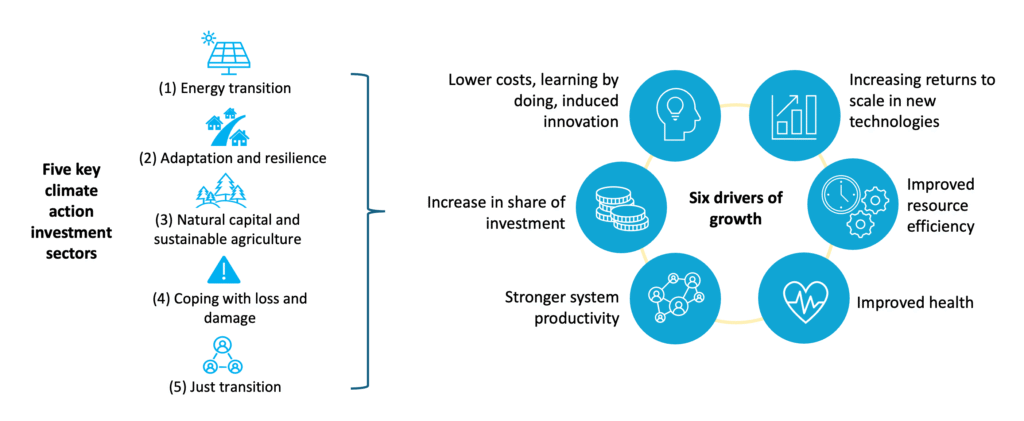
Strong investments and innovation are necessary across the whole economy – see Figure 1 for five key climate investment areas. Such investment must reach all forms of capital, including physical, natural, human and social.
Clean energy investment drives development; natural capital investment underpins it; adaptation and resilience investment sustains it; and just transition investment makes change equitable, desirable and possible. This investment would strengthen demand, supply and efficiency in the shorter term; stimulate innovation and discovery, creating new investment opportunities in the short and medium term; and avoid the destructive impacts of climate change in the longer term. Carbon-intensive growth self-destructs; it is not a viable option.
Alongside the necessary increase in investment, the growth story comes from a number of key drivers (see Figure 1):
- Lower costs and technological advancement, with the clean already being cheaper than the dirty across much of the economy, and innovation proceeding apace across most action areas.
- Increasing returns to scale, shown by many new products and activities.
- Increased resource efficiency, leading to higher productivity.
- Reduced pollution, improving health, reducing mortality and increasing productivity.
- Improvements in the key systems of cities, energy, transport, land and water – for example, cities where you can move and breathe are much more productive than those that are heavily polluted and congested.
AI can magnify these drivers, enabling green and intelligent growth (Stern et al, 2025). See The Growth Story of the 21st Century (Stern, 2025) for a further description of the drivers of growth.
Figure 1: Key investment sectors and growth drivers
The role of the state: five key areas for action
The role of the state as indicated above is crucial to the delivery of the growth story. It will chart a path, and thereby expectations, create the conditions for investments, steer action towards shared objectives and help to bring society together. The remainder of this article focuses on five key areas for state action. These are also priority areas for research, which must move quickly and alongside action. Time is not on our side.
National strategy and direction
Structural change at speed requires strong political support. The state must establish a clear direction and craft a compelling national vision and narrative. And it must act so that some of the tangible benefits of change are experienced directly and soon. It is crucial to foster a shared understanding that the transition is a growth story with sustainable and resilient investment at its core. This narrative both resists the separation of climate and development, and tackles misinformation.
There is no doubt that many challenges will arise, but the role of the state is to make practical choices to overcome them. The narrative should be one of hope, presenting climate policy for what it is: action with the objective of advancing development and wellbeing. It is about technological innovation, modernisation, efficiency, creation of job opportunities, industrial dynamism, resilience and more.
It is a narrative and strategy that highlight both the growth story that action enables and the immense curtailment of rights to and opportunities for development that inaction causes. By creating a hostile environment, climate change can erode fundamental human rights, such as access to food and health, and damage economic and human development across the board. The argument should also embrace a discussion of what is ethical and responsible in relation to future generations and others in the current generation (Stern, 2026).
Such narratives and action plans were embodied in the European Union’s Green Deal and the US Inflation Reduction Act.
Comprehensive management of market failures
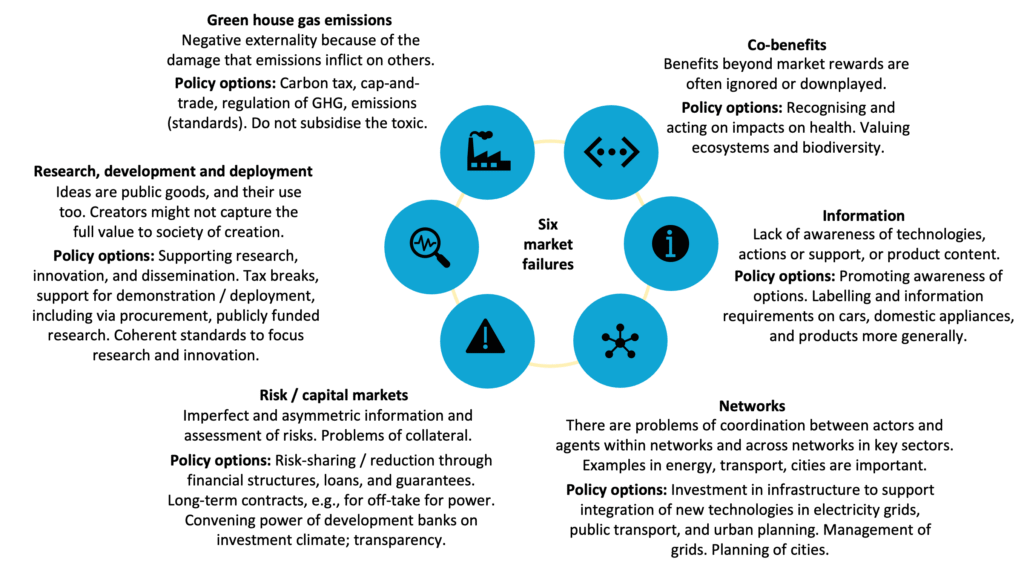
A core task in generating change and building support is the tackling of key market failures (Stern, 2022), thus reframing incentives and helping to create the conditions for the required investment flows. These market failures, which are many and interwoven, must be tackled together in complementary ways.
A narrow understanding of market failures, highlighting only the externality from greenhouse gas emissions, has led many economists to focus overwhelmingly or exclusively on pricing carbon emissions in formulating policy. Such pricing is indeed a critical part of policy, but it must be complemented by action on other key important failures.
These include research and development (R&D) and innovation, which stem from creators’ inability to capture the full value of their ideas due to knowledge spillovers. Without policy, that leads to under-investment in innovation. Research shows that combining carbon pricing and R&D can be much more powerful than carbon pricing in isolation (Acemoglu et al, 2012).
Another critical market failure concerns networks. Without policy, markets do not adequately account for network interdependencies and can ignore systemic risks and opportunities. Understanding and acting to improve ‘feedbacks among interacting elements’ (Catanzaro and Buchanan, 2013) can bolster efficiency and unlock economic value. For example, the quality of urban mobility is linked to urban planning decisions, the value of having an electric car to the availability of chargers, the viability of clean energy generation projects to grid availability, and so on.
Further important market failures concern information – for example, on how products have been made and other co-benefits where health from avoided pollution can be of great importance (see Figure 2). Capital market imperfections can hinder finance for the strong new investments that are required – development banks can play a key role here.
Figure 2: Key market failures related to climate and sustainable development
Institutional strength, governance and the investment environment
Policy predictability, coherence and a clear direction of change are all fundamental in building the confidence needed to foster investment in the green transition. Policies will change as circumstances change and learning takes place.
But for investor confidence, such change should be ‘predictably flexible’. Criteria for flexibility should be transparent – for example, reducing subsidies for renewables as and when costs fall and diffusion occurs. Concerted action across government, to foster policy alignment, and convening stakeholders, to generate cohesive action, can advance investment more quickly than measures that are uncoordinated across ministries.
‘Country platforms’ can provide mechanisms for coordinating the mobilisation of domestic and international sustainable finance in alignment with national development priorities. Standards and regulation can guide investments and signal which forms are consistent with the long-term trajectory of the economy, in alignment with sustainability goals. As far as possible, sharing standards and coordinating strategies across countries can enlarge markets and accelerate progress (Bhattacharya et al, 2025).
An example of consistency in policy-making is in Uruguay. The country has attracted clean investment and transformed its electricity matrix in less than two decades through sustained and clear policy and regulation. It has also built credibility in innovative ways: by holding itself accountable for climate action, having established a sovereign bond with a structure where, if its aims are not met, it will pay a higher interest rate (Godfrid et al, 2025).
Further, creating a positive investment environment requires strong macroeconomic policies, which are fundamental to ensuring the high investment levels needed in sustainable sectors are translated into increased output and not just a crowding out of private investment. Debt management is part of that story. Legal institutions are also of great importance in offering clarity on obligations and for dispute resolution.
Industrial policy for a dynamic and green private sector
Fostering private investment in the new growth story requires tackling market failures, building credibility in strategy and policy, and creating a strong investment environment across the whole economy. It also involves identifying where a country’s clean economic potential and comparative advantage lie. Such was the case with the Danish government’s support for private firms and entrepreneurs in the wind power sector, which was key to creating the country’s renowned innovation ecosystem (Technology Executive Committee, TEC, 2023).
Providing the right support requires that each country crafts tailored measures, as Japan did through its Ministry of International Trade and Industry, which selected and ‘nurtured’ industries through customised measures such as tax breaks and low-interest loans, accelerating their development (Johnson, 1982). Industrial clusters can drive sectoral growth by enabling economies of scale and collaboration, as seen in China (World Economic Forum, WEF, 2026).
Fortunately, the misguided sneering at ‘industrial policy’ typical of the years of market fundamentalism of the 1980s and 1990s has subsided. Building new industries and transforming technologies in a purposive way requires strategy and policies.
While the majority of investment for the transition will be private, there will also be a critical role for public investment, a crucial element of the role of the state. For example, public transport will play a fundamental role. In many countries, the electricity grid will be owned by the public sector. In many cases, this infrastructure facilitates private activity and builds for long-term growth and prosperity.
Finance will play a key role in fostering a green private sector. Priorities include reducing investment barriers, such as high costs of capital. This frequently involves better management and sharing of risk. Given that domestic capital markets in many emerging markets and developing countries are shallow, facilitating access to financial instruments, such as foreign exchange hedging, as Brazil’s finance ministry has done through its Eco Invest programme, can have catalytic effects.
Adequate access to finance is also of importance for households, whose transition requires their own investment. Often poorer households face a higher cost of capital. How households and organisations are supported and costs distributed is a key part of policy for the transition. The national and multilateral development banks can play a central role both in helping to create the conditions for investment and in managing risk and reducing the cost of capital.
Building stability in trade and collaborating across frontiers in innovation and clean energy generation can accelerate the drivers of the growth story, with positive spillovers across countries. State leaders should work through coalitions of the willing to foster market expansion, resource sharing, cohesive policy-making, access to finance and more, contributing both to resilient supply chains and fostering innovation.
Building trust and coordination across countries can generate predictability, while conflict and volatility can be dangerous. Multilateral action is also of importance in tackling the debt, fiscal and financial constraints confronted by emerging markets and developing nations (Stern, 2021).
Public discussion, social buy-in and workforce adaptation
When the transition plans are put into action, there will be deliberate structural change at speed and scale. Some vested interests will push back, in particular fossil-fuel sectors where high rents are at stake. Without pro-active state action, ordinary citizens will face challenges that will understandably create opposition, from dislocation to increases in the cost of living. Careful policy design must manage these risks while pursuing the economic and social gains from change, which will vary across countries with different systems and structures.
Public action will be necessary to help to overcome dislocation, particularly by investing in people and places to create new opportunities, or by providing low-cost capital to help households to manage change. Some vested interests will have to be confronted head-on. Public discussion and building a shared understanding or narrative are crucial to political and social ‘buy-in’. That discussion will often be focused on localised interactions.
It is critical that policy sustains social buy-in and, for this, that the benefits of the transition are shown early. Successful interventions require designing policy packages that account for and reconcile varied interests, articulating and managing negative impacts well in advance.
Still, not all challenges can be foreseen; there will be difficulties and learning that arise along the way. As emphasised, being flexible while maintaining predictability is a critical element of policy-making, both for investment and acceptance. Thus, political systems must remain open and receptive to public input and should be active in initiating civic dialogue.
What Jürgen Habermas called the public sphere – the space in which public opinion is formed – can take many forms, including citizens’ assemblies. Well-managed transitions, rather than generating backlash, should benefit communities and their workers, potentially increasing support for incumbent governments. For example, one study suggests that Spain’s coal phase-out process had some electoral success, with government, industrial and social discussion playing an important role (Bolet et al, 2024).
Research and action
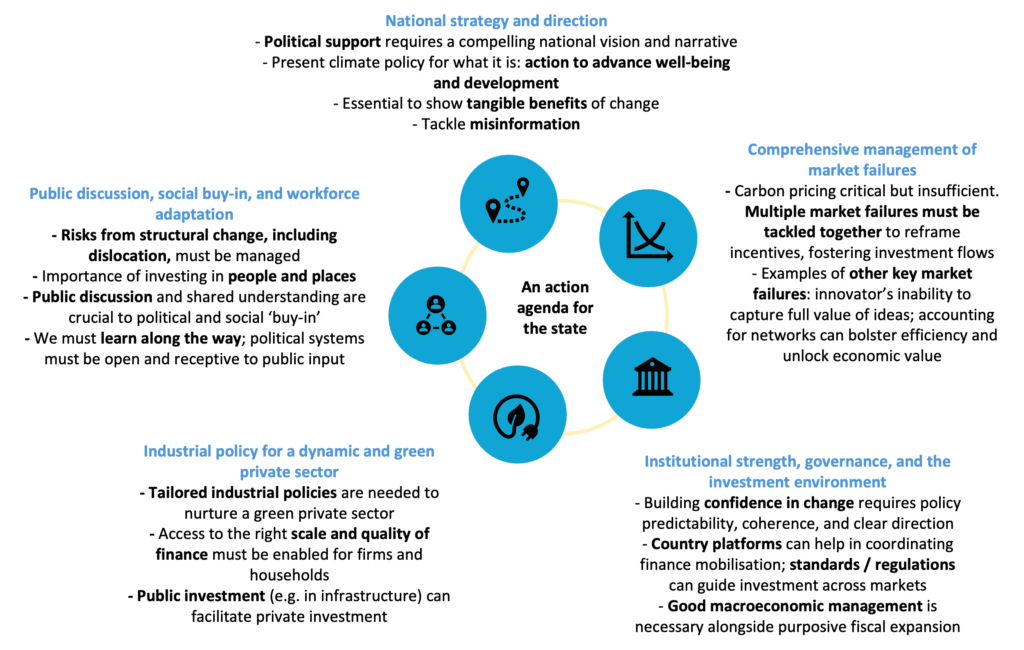
The five areas of action described (see Figure 3) are also five areas for research. In its pace and scale, the necessary transformation is unprecedented in economic history, except in wartime.
The urgency means that this is ‘public policy as if time matters’ (Stern, 2018). It concerns structural and systemic change across the whole economy of a nation. And it will lead to a new economic geography where activity moves towards low-cost clean energy. It will require financing for investment to move much more strongly into emerging markets and developing economies, where the majority of future economic growth will occur.
These are great challenges for both action and research, and they require a new economics of structural transformation. But research and action must move together. Delay is dangerous.
Figure 3: The role of the state – an action agenda
Where can I find out more?
- The Growth Story of the 21st Century: The economics and opportunity of climate action: 2025 report by Nicholas Stern, published by LSE Press.
- Why climate action is the economic opportunity we must seize: 2025 article by Nicholas Stern.
- Innovation, growth and the transition to net-zero emissions: 2021 article by Nicholas Stern and Anna Valero, published in Research Policy.
Who are experts on this question?
- Nicholas Stern
- Anna Valero
- Robin Burgess
- Joseph Stiglitz