The 2026 election for the Welsh parliament is likely to produce a seismic result, one that would end over a century of Labour dominance in Wales. Two blocs of parties offer different visions for a time of high economic uncertainty and worrying trends in employment, earnings and living standards.
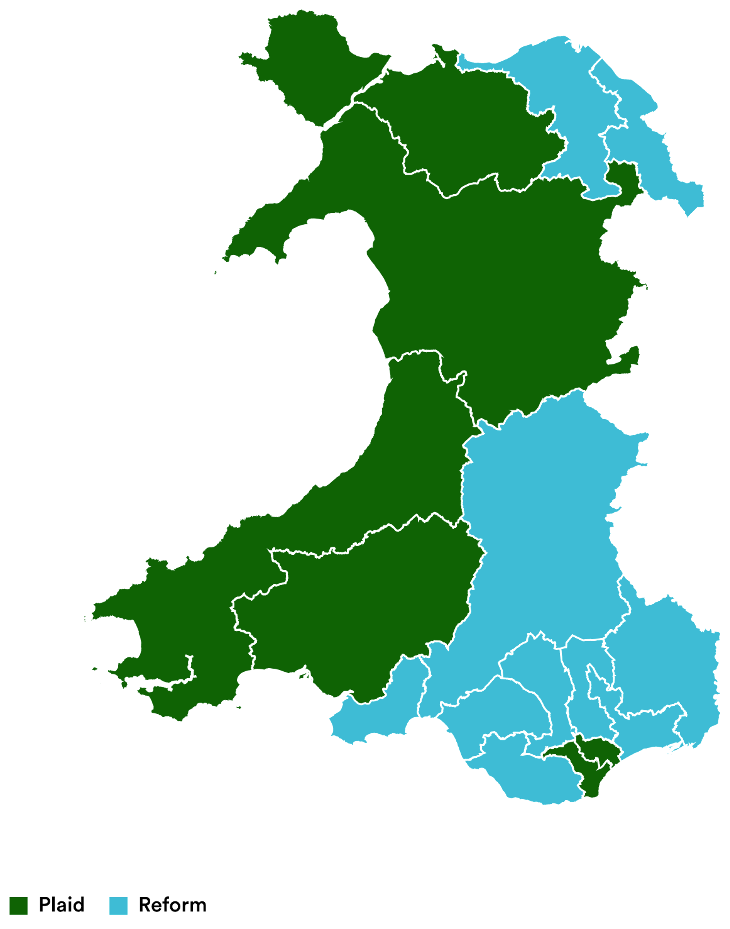
If current polling is to be believed, the race to be the largest party at the 2026 Senedd election is between Plaid Cymru and Reform UK. Welsh Labour – which has won every general election in Wales for 104 years – looks some way behind in third, with the Green Party, the Liberal Democrats and the Welsh Conservatives vying for enough votes to win a share of seats.
Figure 1. Senedd constituency projections
Source: YouGov MRP central estimate, April 2026 (n=3,069)
Notes: People were asked: If there were a Senedd (Welsh Parliament) election tomorrow, which party would you vote for?
An added uncertainty this time around is a new electoral system, which comes alongside an expansion of the Welsh parliament from 60 to 96 members. Sixteen large constituencies will each elect six members through a form of proportional representation. No party is currently likely to get the 49 seats required to form a majority government.
Amid the jubilation, despair and exhaustion on the 8th of May, attention will immediately have to turn to negotiations on forming a government. Based on voter behaviour and manifesto proposals, there are two clear party blocs – broadly on the left and on the right – which will be likely to have to work together to govern Wales over the next Senedd term.
Manifesto plans: meaningful choice for voters
One of the principal rationales for devolving tax powers to the Welsh government was to enable parties to offer competing levels of taxation and public spending at elections.
All parties are promising improvements in, or expansion of, health services, which will require significant real terms funding increases over the coming years. This is unsurprising given the current performance of the Welsh NHS and with health being among the top two most important issues (alongside the cost of living) cited by voters at this election.
Figure 2. What issues should the Welsh government prioritise?
Source: YouGov Polling
Notes: Percentage of respondents saying each issue should be a top priority for the Welsh government
Beyond health, this election offers the clearest instance yet of a meaningful divergence in devolved fiscal policy for Welsh voters to consider.
Since a 10p share of all income tax rates was devolved to the Welsh government in 2019-20, there has been no change in the Welsh rates of income tax, meaning no difference in the income taxes paid by Welsh taxpayers compared to those in England and Northern Ireland.
The Welsh Conservatives propose lowering the basic rate by 1p in the pound, while Reform proposes a 1p reduction across all three income tax bands. Both policies would have a material effect on the Welsh government’s budget for day-to-day spending, with most of the gains going to the top half of the income distribution.
Most parties (with varying detail) propose reviews, reforms or specific reliefs for business rates, while the Welsh Conservatives also plan to abolish the land transaction tax for primary residences (equivalent to stamp duty in England).
On the spending side, childcare has emerged as a key election issue, perhaps driven by the fact the current offer for Welsh parents of younger children has fallen substantially behind the rest of the UK. All parties bar Reform are proposing an expansion of childcare provision and funding, with Welsh Labour planning a more modest expansion and the Welsh Lib Dems proposing the most expansionist offer.
Other spending proposals include fare caps or expanding free bus travel (the Green Party, Welsh Labour and the Welsh Conservatives), expanding free school meals (Plaid Cymru, Welsh Labour and the Greens) and reforming or increasing farm support (the Welsh Conservatives, the Welsh Lib Dems and Reform).
Some parties propose using private finance to fund capital investment; for example, to build the M4 relief road (Reform) or several new hospitals (Welsh Labour). With the capital budget set to decline in real terms over the coming years, using such ‘off-the-books’ financing arrangements would allow more investment, but it would ultimately prove to be more expensive as the Welsh government eventually repays costs from its day-to-day spending.
The fiscal outlook: difficult choices for the next Welsh government
The manifesto spending and tax promises are difficult to reconcile with the current outlook for the Welsh government budget.
Based on the spending plans of the UK government – which remains the most important determinant of Welsh budgets – day-to-day spending will increase by an average of just 0.7% per year in real terms over the course of the Senedd term. The difficulty with this outlook is that if one half of the Welsh budget – the NHS – grows in line with recent and long-run historical trends (of 3.6% per year in real terms), then non-NHS spending will be squeezed in real terms.
With existing public services under significant strain and facing cost and demand pressures, the scope for additional spending commitments and/or tax cuts therefore appears limited. As such, the feasibility and affordability of the manifesto plans have been a prominent campaign issue, with no party producing detailed costings and each party leader grilled on this issue in debates and interviews.
But the fiscal outlook is highly uncertain, and the UK government’s spending plans are likely to change, as they invariably have over recent years. In the context of the next UK general election, which is likely to be scheduled for 2029, spending on public services may well grow faster than current plans imply. If they do not, increasing NHS spending alongside the various manifesto commitments on childcare, education, transport, social care and taxation will require significant cuts to some public services and/or tax increases. The manifestos are largely silent on how these trade-offs would be managed.
In negotiations and agreements to form the government and pass budgets, common ground on manifesto commitments between parties within each bloc will be relatively easy to find. These negotiations will also eventually have to turn to some more difficult choices.
The economic outlook: highly uncertain and gloomy
As parties have been announcing their plans and policies for devolved services and taxes, the campaign has arguably felt relatively muted in comparison to the massive geopolitical and economic shifts taking place across the world. Although international relations is not a devolved issue, recent world events will catch up with whomever forms the next government.
The economic outlook is more uncertain that at any time since the start of the pandemic. Most pressingly, a large spike in inflation this year would be likely to blow even the best-laid fiscal plans off course, with implications for the cost pressures facing public services and the public sector pay bill.
It will also be another hit to living standards and the cost of living, which is the other major issue for Welsh voters at this election. In the data we have up to 2023, real household disposable incomes fell more sharply in Wales than the rest of the UK as inflation spiked from 2021 to 2023. On current projections, living standards are likely to have fallen in real terms over the course of the last Senedd term.
Figure 3. Wales has one of the lowest household incomes in the UK
Source: ONS Regional GDHI, 1997–2023
Notes: Gross disposable household income (GDHI) per head, UK regions, 2023 (£)
The prolonged dismal growth of the UK economy since the global financial crisis of 2007-09 has exacerbated the longstanding relative gap in economic performance with the rest of the UK, which has not closed since the start of political devolution in 1999. Productivity and earnings are lower on average than in the rest of the UK, the employment rate gap is once again growing, and Wales has the highest child poverty rate of all four UK nations.
Figure 4. Wales has the highest child poverty rate of the four UK nations
Source: DWP Households Below Average Income, 2025
As Wales appears to be on the verge of electing a new lead governing party for the first time, dealing with the nation’s intractable economic problems will need to be a key priority. As in the case of improving public services, global economic headwinds and a difficult fiscal outlook will make this a huge challenge.
Where can I find out more?
- Setting the scene: Wales on the eve of the 2026 Senedd election: March 2026 report by Guto Ifan, Ed Gareth Poole and Owain Cynfab.
- 2026 Senedd election analysis: the fiscal outlook: Thinking Wales report by Guto Ifan.
- Welsh election 2026: analysis from the Institute for Fiscal Studies (IFS).
Who are experts on this question?
- Guto Ifan, Cardiff University
- Richard Wyn Jones, Cardiff University
- Ed Gareth Poole, Cardiff University
- Owain Cynfab, Cardiff University
- Helen Tilley, Cardiff University
- Jac Larner, Cardiff University
- Jonathan Bradbury, Swansea University
- Gareth Davies, Swansea University