To understand the core ideas in what is widely regarded as the founding text of economics, it is useful to revisit other works by its author, as well as the philosophies that informed his thinking, not least how successive generations of scholars had made sense of an apparently disorderly universe.
One of the most important contributions that Adam Smith made in founding the discipline of economics was in explaining how all its parts fit together. The division of labour, the invisible hand and natural liberty are all familiar concepts. But in The Wealth of Nations, they belong together as a system of components and connecting chains through which a society could become more prosperous.
Many questions remain about how we should think about that system today. Do we forget about the whole and parse Smith’s work for convenient quotations? Shall we use the caricature of Smith to support or to bash simple notions of the free market and self-interest? Is Smith’s original system itself still relevant at all?
Evaluating such questions means thinking about the evolution of science itself – something that Smith took up in a ‘juvenile work’ called The History of Astronomy. This essay, published after his death but written during his formative years (possibly as an unhappy student in the 1740s at Balliol College, Oxford) traced how successive generations had made sense of an apparently disorderly universe. For Smith, philosophers construct what he called imaginary machines – arrangements of moving parts and connections that made observed events intelligible.
How explanations change
Smith was interested in how such imaginary machines change over time. The process begins with something unexpected. When new evidence or a new way of thinking interrupts a familiar sequence of events, people feel surprised and then wonder at what connection could make it explicable. A system that supplies that connection earns our admiration and makes the world easier to comprehend. Systems that become over-complicated in accommodating new observations lose that appeal, and graceful explanatory power can be a source of pleasure.
Successive astronomical systems did this in different ways. Ptolemy’s Earth-centred account became increasingly elaborate as additional devices were introduced to accommodate new observations. Copernicus offered a Sun-centred alternative; Kepler described elliptical orbits; Newton connected movements in the heavens and on Earth through gravity. Smith admired the reach of Newton’s explanation, while remaining conscious that a system was still a construction of the imagination.
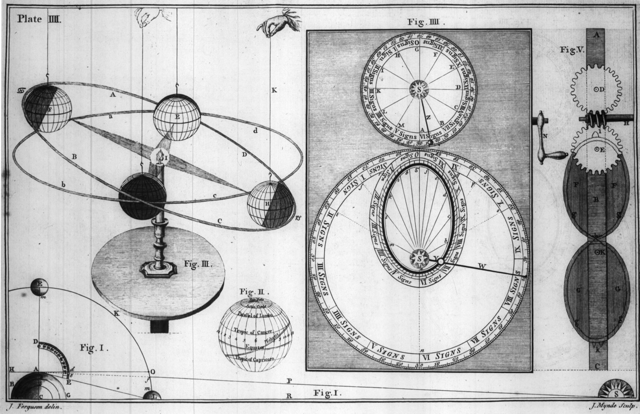
Astronomical models from James Ferguson, Astronomy Explained upon Sir Isaac Newton’s Principles (1756). Drawn by Ferguson and engraved by J. Mynde. Smith's personal library included a copy of Ferguson's, as recorded in Adam Smith's Library, University of Glasgow.
This is not the language of a modern textbook on scientific method. Smith judged systems by their capacity to ‘soothe’ the imagination. An explanation could persuade through the coherence of its account as well as through its correspondence with observations. His discussion invites us to ask why a theory is convincing, and whether our confidence survives new evidence.
There is a connection here with Deirdre McCloskey’s book The Rhetoric of Economics (1998). Economists persuade through examples, analogies and the form of their arguments, including precise mathematical ones. Elegance can make a system attractive, but it does not settle whether its account of causation is right. Nor is precision alone persuasive.
The Wealth of Nations can be read as Smith’s imaginary machine for economics, but his Astronomy points to the conditionality that he himself would place on that machine. He wrote at his particular time, based on his extensive reading, his limited travels and his interaction with other greats of the Scottish Enlightenment (on Smith’s life and his background, see Ross, 2010; Broadie, 2012; Smith, 2020).
While powerful, the account is, by Smith’s own argument, not the final word. While much of that original system remains relevant, we should not preserve it out of respect but understand and interrogate it seriously. This is the approach that I and a group of leading economists and economic historians take in The Wealth of Nations at 250: Understanding Prosperity and Development in the Modern World. To think about refinements to the imaginary machine, we first need to establish what Smith wrote.
What makes a nation wealthy
The full title of Smith’s book places the nature of wealth before its causes. That ordering matters. A mistaken account of what wealth consists of can lead to policies that obstruct its creation. Smith’s target was the mercantile system, especially the identification of national wealth with piles of gold and silver. From that starting point, a favourable balance of trade brought treasure into the country, and restrictions on imports could make the nation richer. Countries appeared to compete over a limited prize.
Smith directed attention instead to the goods that money could purchase and the production that made those goods available. A nation’s prosperity depended on what its people could produce and obtain through exchange. The opening of The Wealth of Nations establishes the annual supply of the necessaries and conveniences of life as the object to be explained.
This fundamentally changed the assessment of trade. He observed that while wine could be made in Scotland, it would be at around 30 times the expense of importing wine of comparable quality. Labour and capital devoted to costly domestic production were resources unavailable for more advantageous uses.
Trade could therefore benefit both parties. Each could obtain goods more cheaply than by producing everything for itself. Smith’s argument also concerned the direction of investment: privileges and restrictions could steer capital towards politically favoured activities and away from more productive ones. The question was what a policy did to the process of generating prosperity.
How the parts of Smith’s system work together
The division of labour supplies the best-known part of Smith’s system, with production increasingly separated into multiple tasks. Repetition of each step improves worker skill, time is saved in moving between tasks, and it becomes possible to introduce machinery that simplifies or replaces particular operations. The same labour produces much more. But specialisation is worthwhile only if there are enough customers. Someone who spends all day making pins needs a market large enough to absorb the output. The extent of the market therefore limits the division of labour.
Cheaper transport widens that market. Larger markets support further specialisation, which raises productivity and creates additional opportunities for exchange. Capital accumulation supports the process by providing tools and maintaining workers while production takes place. The separate mechanisms reinforce one another.
Smith’s case for liberty follows directly from this account. Individuals can seek opportunities, change occupations and direct their resources towards uses that they judge to be promising. Competition restrains their ability to profit by charging more. Restrictions on entry, monopoly privileges and barriers to movement all interfere with the working of that system. This is why treating Smith simply as a defender of business interests is misleading.
The people in this system also inhabit the world of Smith’s other great work, The Theory of Moral Sentiments, first published in 1759 and revised throughout his life. People care about others’ judgements and seek their approval. The impartial spectator represents an internalised regulator by which individuals examine their own conduct. Self-interest operates within social relationships and moral expectations.
The ‘invisible hand’ then captures the possibility that these individual efforts, while incorporating those internalised moral sentiments, also serve a public purpose. Someone seeking a return on capital can contribute to national output without even intending to benefit society. This creates a presumption in favour of individual people directing their own economic activity. Smith’s view of policy and institutions is built directly from his economic system in The Wealth of Nations.
The institutions of commercial society
Justice is essential since commerce requires protection against injury as well as reliable rules. Smith’s account of natural liberty leaves government with duties of defence, justice and public works that would benefit society but would not repay the expense of private provision. For example, roads and bridges can enlarge markets: their provision is part of the explanation of prosperity and part of a role for the state.
Education illustrates another connection within the system. The division of labour raises productivity, but a lifetime spent performing a few simple operations can, Smith thought, narrow a worker’s mental capacities. He consequently advocated public support for elementary schooling. Here, the source of an economic gain could itself create a problem requiring public action.
Smith also recognised circumstances in which liberty should be curtailed. Necessary banking regulations are analogous to rules that require party walls to stop fires spreading between buildings. It is understood that an individual’s freedom to act can sometimes create dangers for others.
The limits of the original machine
Smith expected that his system pointed to ways in which substantial improvement could be made to the living standard of societies. But his account did not anticipate the sustained expansion of living standards that followed. As Tony Wrigley explained in Continuity, Chance and Change (1988), Smith’s conception of growth approached a ceiling: a commercial society could attain a high degree of opulence, rather than keep expanding indefinitely.
The history of the following two and a half centuries poses a larger problem. We need to understand how that apparent ceiling was broken, why the transition occurred at different times across the world, and which activities the original account failed to recognise.
The astronomy essay helps to clarify the task. Improved observations can require a revised explanation. In economics, the institutions and behaviour being explained can themselves change. Both our means of seeing and the world that we see have developed since 1776.
An earlier Economics Observatory piece takes up that task. It begins with the challenge that Wrigley identified, the emergence of sustained growth that Smith’s machine did not anticipate, and draws on the contributions to The Wealth of Nations at 250 to ask which parts of Smith’s system still hold, which new parts are needed and where his judgements have been contested.
Where can I find out more?
- The Theory of Moral Sentiments.
- The Wealth of Nations.
- The Wealth of Nations at 250: Understanding Prosperity and Development in the Modern World.
- Celebrating 250 Years of the Wealth of Nations – University of Glasgow.
- The Rhetoric of Economics.
- Smith on Philosophy and Religion.
Who are experts on this question?
- Thomas Ahnert
- Benjamin Friedman
- Deirdre McCloskey
- Jesse Norman
- Emma Rothschild
- Graeme Roy
- Craig Smith
- Alex Trew