More often than not, the political answer to the North of England’s economic challenges is more trains. Yet while fresh investment in rail infrastructure may boost prosperity in certain places, it isn’t the catch-all solution that some politicians present it to be.
The answer is trains. What was the question again? That’s what most discussions about improving the North of England’s economy can feel like. Policy announcements seem stuck in this loop too: successive governments have announced versions of Northern Powerhouse Rail, most recently as part of a £45 billion plan.
Sometimes trains will be the answer to increase access to prosperity. But they won’t be the answer every time. This article shows why using two examples: the proposed re-opening of the Leamside Line in the North East; and a proposal to put extra stops on commuter routes into Leeds.
What is the role of transport in the economy?
A principal day-to-day role of transport in the economy is to connect people to jobs. Better connections open up job opportunities for workers and expand the pool of workers from which employers can choose.
Cars can and often do this. Trains and trams come into their own when:
- It’s difficult to get to a particular place of work by car because so many people are trying to get there (think central London).
- The wages on offer are high enough to make the more expensive train journey into the centre worthwhile (richer people are much more likely to take the train than poorer people because it’s a more expensive way to travel), and people have the skills to access these jobs.
- There is a volume of people living close to a train station to make a frequent service viable.
The re-opening of the Leamside Line and new stations in West Leeds
Let’s assess two potential rail upgrades in the North of England against these metrics.
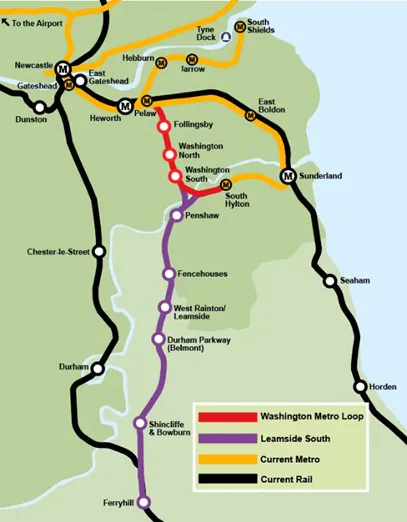
The North East’s plan to re-open the Leamside Line is being led by the North East Mayor and it has received cash to develop proposals in the government’s recent Northern Powerhouse Rail announcement. The disused line runs parallel to the East Coast Main Line from Gateshead and goes through County Durham.
The proposed re-opening has two phases. The red section in Figure 1 would be an extension of the existing Tyne and Wear Metro light rail network, while the purple section would be an addition to the heavy rail network. Mayor Kim McGuinness says that the re-opening is a ‘once in a generation’ opportunity and ‘will be transformational for local people’.
There is no confirmed cost for the purple section of the project (the part on which this article focuses for reasons of data availability for the modelling below), but initial scoping indicates a price of least £1.1 billion.
Figure 1: The proposed Leamside Line re-opening
Source: www.leamsideline.co.uk
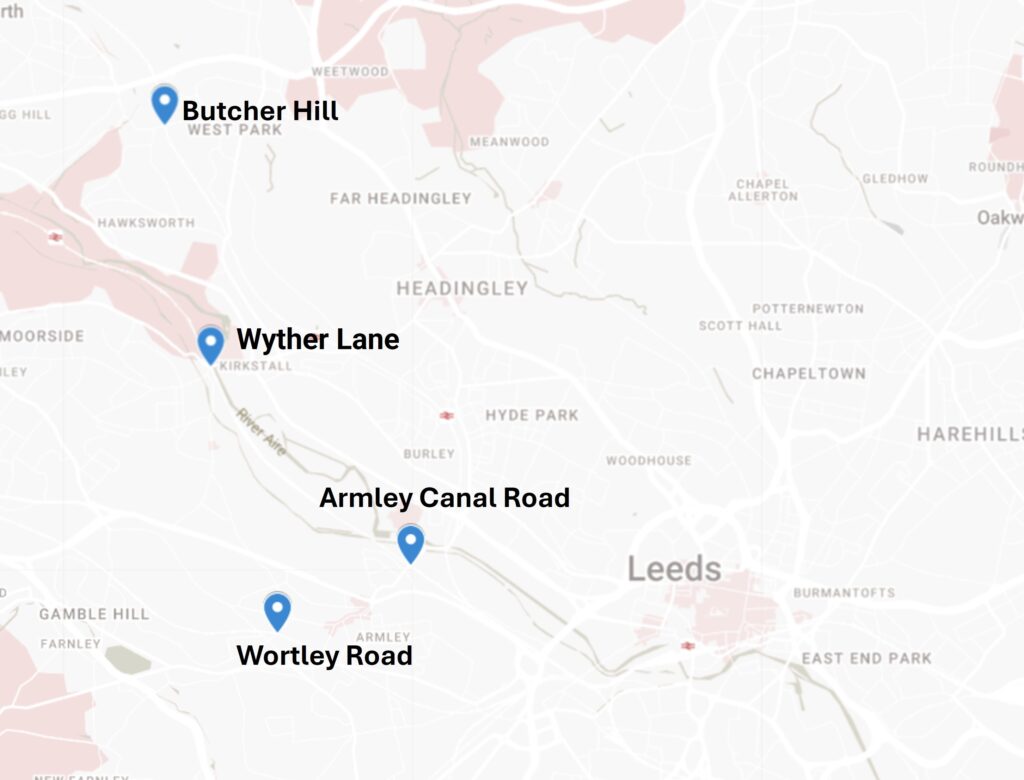
The second proposal is an idea to re-open or add to stations on commuter lines going into Leeds from the west. These stations are not currently part of public discussions on transport policy. But the continuing challenges around building a tram in Leeds, combined with the growth of its city centre and peak time congestion – for example, the route of the number 16 bus running from Armley Canal Road to the city centre is already timetabled to take 1.8 times longer at peak time, but in reality takes 2.2 times longer – make them a contrast to where policy is funding new rail proposals.
The station locations have been chosen because they have either been part of suggestions in the past (Armley Canal Road, Wyther Lane) or they break up a large stretch of line within the suburbs of Leeds (Butcher Hill, Wortley Road). Figure 1 shows where they are.
Figure 2: Locations of proposed stations in Leeds
Source: Google Maps
Since these re-openings are not live proposals, there are no costs attached to them. But taking the construction of a new station at the nearby White Rose Centre as a guide (£27 million), opening these four stations would cost £108 million (a tenth of the cost of the Leamside project).
Of course, there may be good engineering reasons as to why the stations could not re-open. But that misses the point of the exercise, which is to show in principle how a station stop in the area would perform, and how this should shape the thinking of economic policy-makers.
How do these stations measure up?
So how do the proposed stations perform against the measures set out above? The charts in Figure 3 show that the Leamside stations in particular do not measure up well. Specifically:
- Access: measuring this by the number of jobs around the nearest destination stations shows that there are not particularly high volumes of people commuting into Newcastle and Sunderland stations.
- Wages: the pay on offer in these centres (measured by the median wage in Newcastle and Sunderland local authorities, as workplace wages aren’t available at a sub-local authority level) is not particularly high.
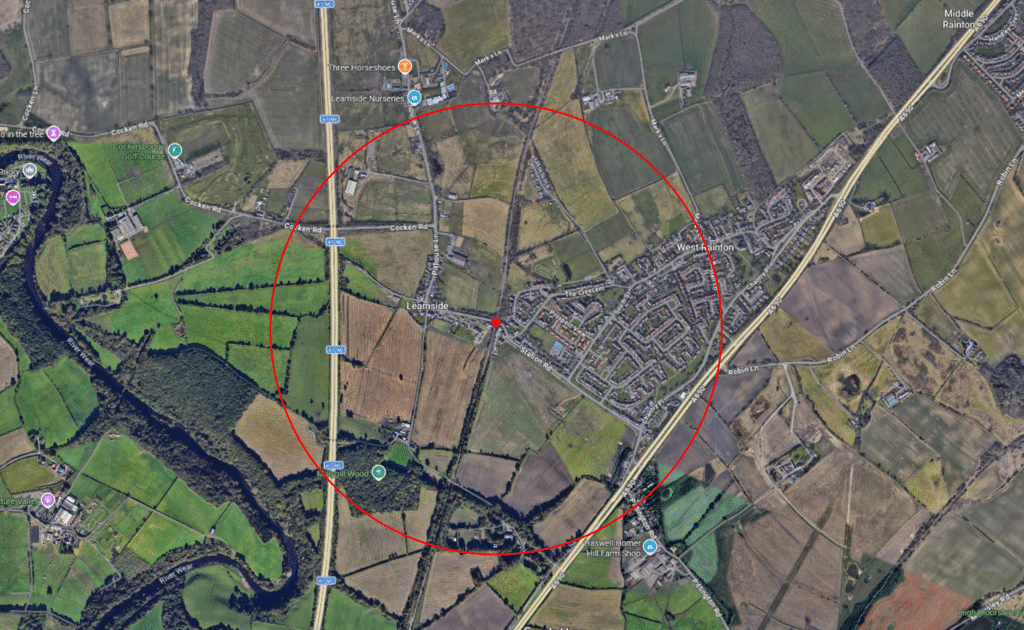
- Population: there are not many people living around the proposed stations. To illustrate, Figure 4 gives an aerial view of the area around the proposed West Rainton station, which is the least populated of the proposed stations.
- Skills: only one station (High Shincliffe/Bowburn) clearly sits above the national average for its share of residents with a high-level qualification.
In contrast, the Leeds stations outperform the Leamside ones across most measures. But at the same time, they do not stand out against other existing stations across any of these metrics.
Figure 3: How the proposed stations perform across a range of measures
Source: Office for National Statistics
Figure 4: The area 1km around the proposed West Rainton station
Source: Google Maps
Putting these data into a regression gives a simple but reasonable prediction of what the likely use of each of the stations would be. Figure 1 shows the results.
For the Leamside Line, all stations would be in the bottom third of existing station usage, and West Rainton would be in the bottom 10%. Reflecting the input data, the Leeds stations all do better, ranking around the middle of the distribution for station passenger usage. But in itself, that does not make a compelling case for upgrade.
Figure 5: Ranking of the proposed stations’ estimated entries and exits compared to those of current operational stations
Source: Author’s calculations
Notes: This is an OLS regression with station entries and exits as the dependent variable and population within 1km, share of this population that has at least a level 4 qualification, wages in the local authority of the most popular destination train station, number of jobs within 1km of this station and a set of regional dummies as independent variables. Stations with fewer than 2,500 entries or exits per year are excluded. All variables are logged, and robust standard errors are used.
Could other policies help to improve the viability of these projects?
Of course, the inputs into this model are not fixed. There are two versions of an argument that would suggest they can change.
The first, which is likely to be used by proponents of a rail investment, is a ‘build-it-and-they-will-come’ argument – that is, that the project will create its own demand. The second is that policy can encourage demand by making a number of other changes simultaneously (such as building homes around new stations) alongside the train investment to make the rail intervention more viable.
These arguments both have merit. But whether they work will depend on the wider economic context of the place.
For people to want to commute by the train, there have to be high-paid jobs at a destination station to make the journey worthwhile. As shown above, that’s currently a challenge for Newcastle and Sunderland in particular, and so doesn’t suggest that build-it-and-they-will-come will work.
Policy could work to improve city centre performance, and indeed it is. This is welcome – it’s unlikely that there will be a big improvement in prosperity in the North East or West Yorkshire without an improvement in its city centres.
This is because high-skilled, cutting-edge sectors of the economy disproportionately locate in city centres given the benefits that such locations provide. But Newcastle and Sunderland city centres have struggled to capitalise on this phenomenon.
For the UK’s most cutting-edge activities, Figure 1 shows their propensity to locate in a city centre, and the North East’s share of each industry. It is in those activities that have the strongest preference for a city centre location that the North East especially struggles – the top right of the chart is empty. The result is that the North East has fewer cutting-edge companies per 10,000 population than almost any other UK region.
Figure 6: How much of the UK’s cutting-edge industries in the North East accounts for against the propensity for these sectors to want a city centre location
Source: The Data City
Policy-makers could also build more homes around the proposed stations to increase the number of people living around them. This idea makes more sense in the Leeds case than for Leamside.
By international standards, Leeds, Newcastle and Sunderland are low density cities. This lengthens commutes and reduces the size of the available workforce that a city can offer, reducing their ‘effective size’. It also makes public transport less viable. Given this, a goal of policy should be to change the built form of these cities.
Building more homes around the stations in Leeds would both increase density and make individual stations more viable. For example, doubling the number of people living around Butcher Hill would move the estimated station usage in the model from being middle of the pack to being within the top third of used stations.
While building more homes around the Leamside Line could improve the viability of passenger services, the non-urban location of the stations would mean that such building would double down on the area’s low-density development, rather than redress it.
An alternative strategy would be to attempt to get more out of the rail infrastructure that the area already has. Unlike Leeds, Newcastle and Sunderland both have light rail systems. Increasing housing around existing Tyne and Wear Metro stations would both increase the viability of the network and change the built form of the area. Increasing density would improve the viability of the bus network too.
This suggests that if building of the new stations in Leeds happened alongside building of more housing around them, then trains could well be part of the answer to improving the economy. The evidence is much weaker for the Leamside Line.
What does the wider evidence on rail investment and economic growth tell us?
Despite the widespread policy conviction about the economic impact of trains, the research evidence is much more mixed. Some studies find positive impacts, some negative and some find displacement effects, where the positive impact close to new stations is partly the result of activity drawn from elsewhere.
Examples from around the UK illustrate this well. London’s Elizabeth Line has been well used since its opening, but given the volumes of people and high-wage jobs it connects, this is not surprising. Manchester Metrolink has seen passenger numbers increase in recent years too.
But the history of Sheffield’s Supertram is less positive, which, given the city centre’s struggles to attract high-skill sectors, is again consistent with what the wider evidence would predict.
The one potential counter-example is the re-opening of the Northumberland Line, also in the North East. This project has reported surprisingly strong usage figures since services restarted in December 2024. But reduced ticket prices may well have played a role, something that affects the subsidy required to run the line: the key test will be whether its early popularity is sustained once any novelty effect fades.
What about other benefits of rail investment?
There are of course other potential justifications for re-opening the Leamside Line. One is that it will help people travel for leisure. While this is possible, it suffers the same problem as the commuter argument – there just aren’t many people living round these stations, so it’s unlikely that the stations would have a frequent service to make it more attractive than the car. (Car ownership around these stations is higher than the national average).
Another argument is that it could relieve pressure on the East Coast Main Line, especially by diverting freight. If this is the main benefit, then it should be central in the policy debate, with the costs of the project assessed on this basis: currently, this is not happening.
Could non-transport policy be the answer?
Sometimes the answer to the question of improving prosperity in a place will be trains. But these two potential projects in the North of England illustrate how rail investment is not a universal answer. It is dependent on the economic geography of a place, and a higher number of trains does not automatically mean a stronger economy.
Crucially, this is not an argument for diverting investment away from places – in this instance the North East – but to focus it on things that will make a difference. City centres, housing development around existing metro stations, the bus network and skills are four candidates for funding. The concern is that time, effort and money are being spent lobbying for something that is unlikely to make much difference to prosperity, which is surely an outcome that nobody wants.
While this logic applies locally, it does nationally too. That all parts of northern England are looking for a slice of the Northern Powerhouse Rail cake is understandable. Central government’s approach to spending means that the these areas stand to miss out on investment if they do not propose a transport project. This is a problem if your most effective ‘train intervention’ is not trains at all, but housing and office development. Policy-makers focused on transport and economic development in England’s regions should reflect on this point.
Where can I find out more?
- Leamside Line: an explanation of the project by the North East Combined Authority.
- Measuring up: comparing public transport in the UK and Europe’s biggest cities: a report by Guilherme Rodrigues and Anthony Breach.
- Density if done: a blog post by Tom Forth.
- The socioeconomic impact of train stations: evidence from a 20-year study in Sweden: a study by Alexandra Rojas, Carl-William Palmqvist and Rosalia Camporeale.
Who are experts on this question?
- Henry Overman
- Andrew Carter
- Tom Forth
- Daniel Graham